
Photographers who don’t take photos
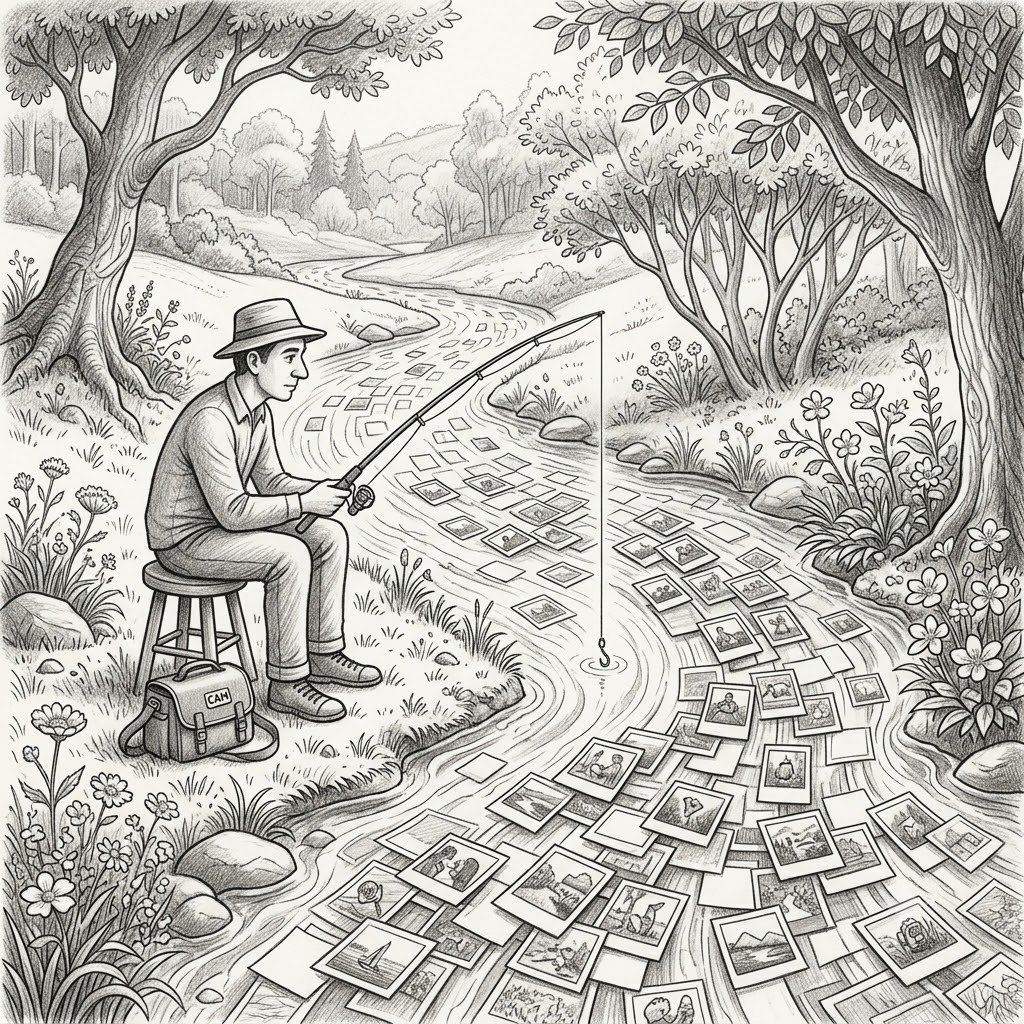
Absurd, isn't it? If any of us are asked to picture a "photographer," the image of someone with a camera in hand immediately comes to mind. A photographer takes photos. Period.
Or do they?
Quoting my beloved Joan Fontcuberta, we live in the post-photographic era, submerged in an "avalanche of images"—a time when the nature of photography has mutated from a medium of representation to a message itself, because we now communicate through images. This new quality acquired by the image—thanks especially to camera phones, the Internet, and social media—causes us to constantly generate photos and more photos, most of which remain in digital limbo (how many photos do you keep on your phone?) without ever being looked at again. And being looked at, after all, is the ultimate purpose of a photograph.
In 2011, an eternity ago, Fontcuberta presented his "post-photographic manifesto," which would later be published as a book titled La furia de las imágenes (The Fury of Images). In it, Fontcuberta, true to his provocative style, claims that there is no need to take any more photos: "the photographer no longer has to produce work, but rather prescribe meaning. They merge with the curator, the collector... any artistic facet is authorial. An ecology of the visual is imposed that will encourage recycling, thereby delegitimizing the original, and appropriationist practices will become normalized."
First off, I haven't stashed my camera in a drawer, nor do I agree with him that taking more photos is meaningless, but I do subscribe to the idea that, in the end, everything has already been photographed.
Many artists have chosen this path of recycling existing photographs instead of creating new images. This is not a recent phenomenon: the avant-gardes of the early 20th century—especially Dadaism, Cubism, and Soviet Constructivism (Rodchenko & co.)—already used collage and photomontage as artistic techniques. Pop art, with artists like Richard Hamilton or Eduardo Paolozzi, picked up the baton, and so, in every decade of the 20th century and what we have seen of the 21st, we repeatedly find exponents of appropriating pre-existing photography.
So, are those who work with existing photographs just as much photographers as those who take them? Or should they be called "visual artists," leaving the term photographer strictly for those who create photographs?
Just like the debate over what is and isn't photography, we arrive at another sterile discussion. Art defies labels and strict definitions, and precisely because it is art, it questions any reductionist attempt. To me, everything is photography and everyone is a photographer: from those working with 19th-century techniques like Sally Mann, to large-format cameras like Alec Soth, compacts like Daido Moriyama, or camera-less processes like Alison Rossiter and her expired film.
Or with images made by others, as in the overview below, divided into three "categories" simply to give a bit of structure to this post.
Found Footage Photographers
These are artists who collect and manipulate prints made by others. Often, their work involves re-photographing the composition, digitizing it, or even presenting it as an installation. We begin with a politically charged heir to pop art, Martha Rosler, who created House Beautiful: Bringing the War Home between 1967 and 1972 as a protest against the Vietnam War. Juxtaposing images from magazine interiors with war photography creates a sense of discomfort that is just as relevant today as when it was made.
Along the same lines, much of the work by duo Adam Broomberg and Oliver Chanarin takes shape, such as War Primer 2 (2011), or especially Holy Bible (2013), in which they pasted war photographs directly onto the pages of the sacred text.
Equally outspoken is the work of Brazilian artist Rosângela Rennó, who found a suitcase (there's always a suitcase, right, Joan?) containing ID photos of thousands of workers who helped build Brasilia. Imemorial (1994) remembers the incredibly harsh lives of those laborers, including those who died during construction and were buried right in the foundations of the buildings they raised.
Kensuke Koike builds visual poems with a craft knife and adhesive. He cuts and rearranges pieces of photos found in flea markets with surgical precision—never adding or removing anything—turning them into hypnotic, sometimes playful, and occasionally unsettling images.
Joachim Schmid, in Archiv (1986–1999), also uses photos of strangers like Koike, but gives them a completely opposite treatment: he collects, arranges, and classifies them by visual similarity without making any alterations. His purpose is to reflect on the homogeneity of utilitarian photographic production, known as vernacular photography.
And I end this section with a deeply personal project, where the old photos are not of strangers, but from the family archive. Yolanda (2014), by Ignacio Navas, originated when he saw a photo of his baptism being held by a woman he didn't recognize. It was Yolanda, his uncle Gabriel's partner, who died of AIDS just a few years later. The work, published as a fanzine, illustrates Navas's obsession with giving Yolanda an identity and, in doing so, constructing a memory he was missing.
Internet and the Digital World
It is clear that digital photography and the Internet have placed ALL photos right at our fingertips, giving rise to reflection on that very "excess and access" that defines post-photography. It is essential to start by citing the pioneer: Erik Kessels and his 24 Hours in Photos (2011), an installation featuring 350,000 photographs uploaded to the Internet in a single 24-hour period, which Kessels printed out to literally flood the space. If there is a work that visually describes post-photography, this is it.
In what we have seen of the 21st century, the appropriation and resignification of digital images rank near the top of artistic photo production. There we find Penelope Umbrico and her world-famous Suns from Sunsets from Flickr (2006) or Corinne Vionnet with Photo Opportunities (2005–ongoing). Vionnet's work fascinates me—so much so that last year we created a humble homage to it for a university project, which I wanted to title We Deserve Extinction, but my classmates, using better judgment, chose another:
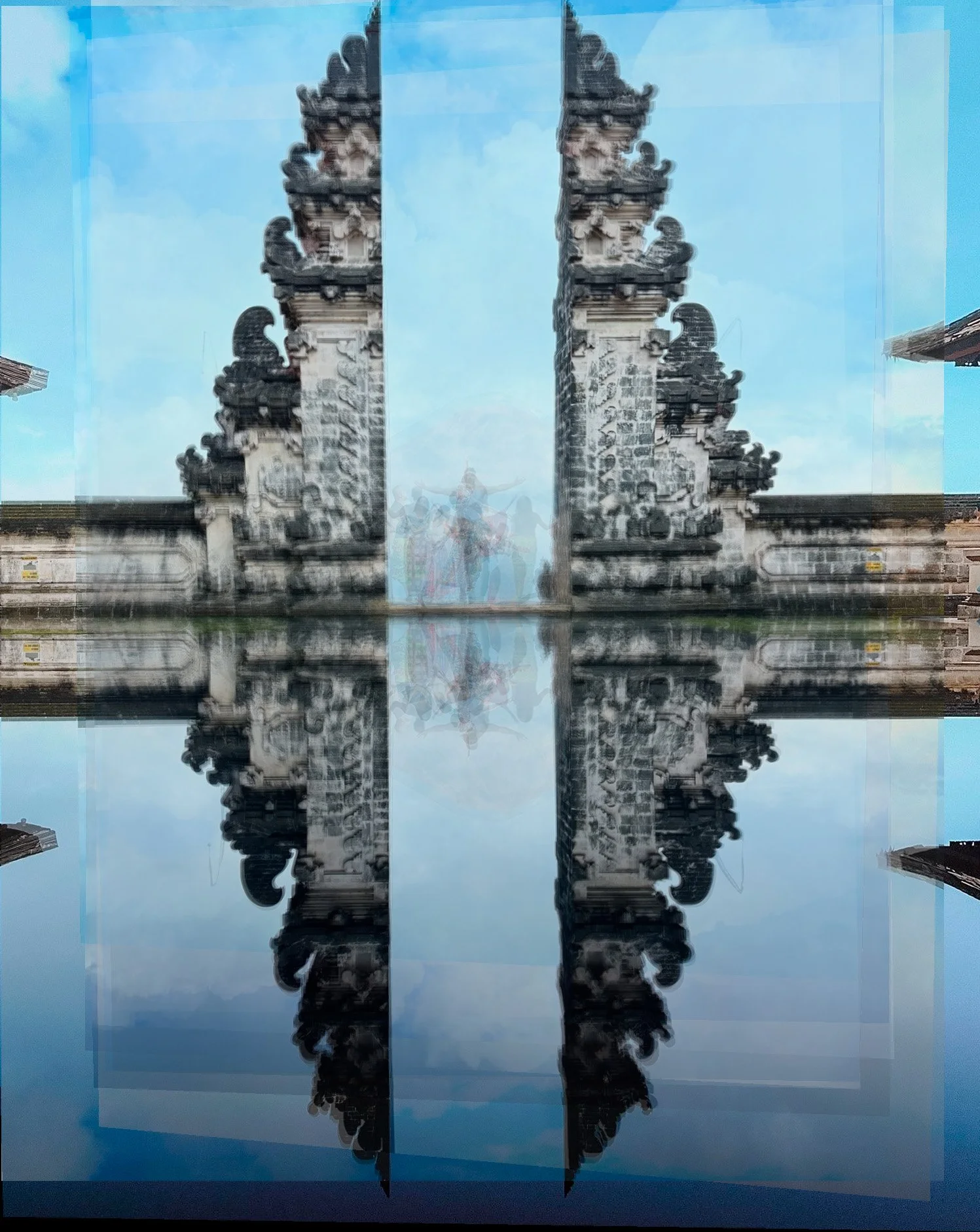
Lempuyangx10. J. Calle, A. Cano, A. López
If you compare this overlay of ten photos taken from Instagram with Vionnet's montages, you'll see a fundamental difference: in our composition, the monument—popularly known as the Gates of Heaven in Bali—is practically sharp, while only the people standing in the center become blurred. This happens because the photo is taken from the exact same spot and with the exact same framing every single time. In fact, a small industry has developed around the location where tourists wake up early, travel two hours to reach the temple (which cannot be visited inside), take a number for a small fee, wait several hours, and when their turn comes, hand their phone to someone comfortably seated under an umbrella to get exactly two minutes to pose. The mirror placed beneath the phone to simulate the reflection of non-existent water is included in the price.
Everyone is happy: the local makes a living, and the tourist posts "a unique photo in a magical place" on social media.
Right.
After that little detour I couldn't help but share, back on social media we have Marc Adelman, who exhibited his work Stelen (2012) at the Jewish Museum in New York. It consists of a series of 150 portraits taken from the profile pictures of users on the queer dating network GayRomeo, all taken at the Denkmal für die ermordeten Juden Europas in Berlin. The series had to be withdrawn due to protests from men who recognized themselves in the photos and felt their privacy had been violated.
Eva and Franco Mattes didn't have that problem in 2021 when they created the video installation Hannah Uncut, sourced from the contents of a woman's phone, Hannah, who sold it to the artists knowing they would share all of its content without filters (hence the uncut).
Naturally, I must mention again Joan Fontcuberta, who, besides being a theorist, is a magnificent artist. In his work Googlegrams (2005), he composed mosaics reproducing well-known photographs out of thousands of images found by searching specific keywords on Google. For instance, the piece reproducing the second plane hitting the Twin Towers was generated using the search terms "God," "Yahweh," and "Allah." He ran the deluge of returned images through free photomosaic software, and voilà.
Specific searches on Google applications also led Mishka Henner and Doug Rickard to create Dutch Landscapes (2011) and A New American Picture (2010), respectively. While the former turned to Google Earth to highlight how the Dutch government "conceals" military sites under colorful geometric shapes, the latter—who, by the way, is also a photographer and the founder of the influential platform American Suburb X—used Google Street View cameras to depict deep America: small towns and suburban neighborhoods. Street photography without leaving home, where the intent is precisely the camera's lack of intent. In my humble opinion, a brilliant piece of work.
But there is life beyond the Internet; specifically, there is life on PlayStation. I end this section with Postcards from Home (2015), by Catalan artist Roc Herms: a collection of images from a reality that doesn't exist. Or does it?
And Now, AI
This is the latest chapter, for now: photographers generating synthetic images from text prompts. And, of course, here is my dear Joan Fontcuberta once again: De rerum natura (2024) is a work I saw exhibited alongside eHerbarium some time ago. In the latter, he revisits his own 1980s work, in which he reproduced Karl Blossfeldt's iconic botanical photographs using waste materials, now generated via algorithms. But the former is the most intriguing: he used descriptions of botanical species discovered in the West Indies, as written by 17th-century naturalist and missionary Bernabé Cobo, as prompts to generate images of those species. The photos, beyond being strikingly beautiful, hold a circularity that transcends time: just as the plants and animals found in America amazed Spanish explorers four centuries ago, today we find ourselves fascinated by the capabilities of a new technology we are only beginning to scratch the surface of.
Also featuring flowers is Jack Latham's Latent Bloom (2020), generating images through an algorithm's deep learning trained on photos of real flowers as input. And how could we forget Jonas Bendiksen's The Book of Veles (2021), generated almost entirely with AI, which circulated widely without anyone detecting the ruse?
In Conclusion
This is a small, tiny sweep through artistic works that demonstrate the concept of "photography" is as elastic as we want it to be. In the end, humans use whatever tools are at hand to express themselves—whether red pigment on a hand to leave a mark on a cave wall, or an artificial intelligence system synthesizing photorealistic images based on our instructions. It is not the tool that defines the work; it is the intention. Having something to say.
